Sedation Dentistry in South Fort Worth
We’ll Make Sure You Are Comfortable During Treatment
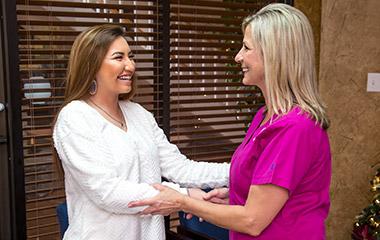
Our friendly staff will make you feel welcome in our office.
Dr. Warren and our staff are committed to making your visits as comfortable as possible. Our warm, friendly atmosphere and our comfort amenities will help to put you at ease, along with our gentle, minimally invasive techniques and advanced sedation options.
Some people experience extreme anxiety about undergoing dental work or even visiting the dentist at all, a fear known as dental phobia. If you suffer from this issue, it can keep you from seeking proper dental care and could be compromising your dental health. We are very experienced at treating patients who have not been able to receive dental care elsewhere due to this, and we can give you the care you need in a low-stress environment.
Friendly, helpful care
Our friendly staff will make you feel welcome and comfortable, and help you with any concerns you may have. Dr. Warren is kind and personable and will take the time to explain your procedures. He wants you to be informed, so you feel confident about your treatment. You can ask him any questions, knowing that he will give you honest answers.
Comfort amenities
We provide various comfort amenities to help you feel more relaxed while you are here. We have cozy blankets and pillows for you to use, along with noise-canceling headphones and free WiFi so you can bring a personal device to listen to music or internet radio stations during your treatment.
Advanced Technology for Minimally Invasive Treatment
Dr. Warren uses advanced, modern techniques and equipment to provide you with gentle, effective care.
3D imaging
Our 3D CT scanner provides Dr. Warren with 360 ° images for use in implant treatment planning or diagnosing complex issues. The images can be magnified and viewed from any angle. For implant treatment, Dr. Warren uses special 3D software that allows him to pre-plan the exact angle and position of your implants with great accuracy.
Dental laser
Dr. Warren uses a gentle, variable-power, soft-tissue laser for minor gum recontouring. Use of the laser makes this a minimally invasive procedure.
Ultrasonic scalers
Our ultrasonic scalers are indispensable for gently yet thoroughly removing stubborn calculus and bacteria during deep cleaning. Ultrasonic scalers are more comfortable than traditional hand instruments, and they are gentler on your teeth.
Gentle Injections
Dr. Warren takes particular care so that your injections are as gentle as possible. He will use a topical anesthetic to numb the gum beforehand, and some patients say they feel nothing at all.
Sedation Options
There are a great many people who are uneasy about undergoing dental work. Sedation allows patients with severe anxiety or certain conditions, such as gagging or vertigo, to receive the treatment they need. Although sometimes referred to as “sleep dentistry,” most patients remain awake after taking sedation medication, and only experience a sleepy feeling.
Dr. Warren is certified in IV and oral sedation. He will review your medical, allergy and anesthesia history prior to any treatment, so that he can recommend the best option for you.
Nitrous oxide
We offer nitrous oxide, also known as laughing gas, as one of our sedation options. Nitrous oxide takes effect quickly—from a few seconds to a few minutes after inhaling. It obscures pain as well as giving patients a feeling of well-being.
Oral sedation
We provide oral sedation as a method for achieving minimal to moderate sedation. This requires you to show up about an hour prior to your dental appointment and take a small dosage of a sedative medication. Most patients become so relaxed that they may actually fall asleep. The medication usually takes several hours to wear off fully, so you will need someone to drive you home after your treatment. Oral sedation is not a “knock-out drug”, but is a very effective sedative.
IV sedation
We also offer IV Moderate Conscious Sedation, which is a safe and tightly controlled method that provides a greater degree of sedation while allowing you to remain fully awake and able to execute our instructions. Dr. Warren will use a combination of IV drugs carefully administered to achieve the desired level of sedation for each patient. The recovery from this type of sedation is fast, but you will need the assistance of a responsible adult to drive you home.
Dr. Warren sometimes also uses the services of a certified anesthesiologist when deeper levels of sedation are required.
To make an appointment, call 817‑241‑2820 or click here to request an appointment online.